
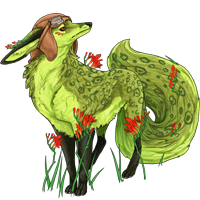
 Custom Glade Neela


Love-in-a-Mist:
Delicate, puffy flowers which commonly come in blue, but may also come in shades of pink, purple, and white. The flower is surrounded by a 'mist' of lacy, fern like foliage. A common sight in English gardens since Elizabethan times. Symbolises perplexity and delicacy.
---
(Under construction; not finished)
She was born in the Year of Our Lord, 1564, during the reign of her Majesty Queen Elizabeth I. Appropriately or not, the exact date was April 1st, known then as All Fool’s Day. Though being born into a rather influential noble family, Isabell was raised as a Lady, and any mischief she might have caused during her early years was heavily frowned upon. Her first decade was uneventful; she was taught all those skills that an educated Lady should know, as well as prepared by her mother for the married life she was destined for. After all, a Noblewoman though she was, Isabell was still a girl, and with three brothers and another sister besides. Their fortune would be split amongst her brothers, while she would be married off to some suitable young Lord.
Isabell was approached by various would-be suitors as she came of age – besides her family’s assets, she was not unattractive – but for one reason or another, her parents, or rather, her father, found fault with them all. Though many of the proposed matches were respectable enough, Isabell’s father was proud of all his children, and was determined that his daughters would only marry men who would truly care for their needs. It was not until Isabell was seventeen that a suitable match was found, in the form of young Lord Peter Heron, her senior by ten years, and by all accounts an intelligent, handsome man. Facts he seemed well aware of, for Isabell did once remark privately to her sister that the man was in possession of an ego that could fill Hampton Court thrice-over. Nevertheless, Isabell had no real complaints about her suitor, indeed, on the rare occasions she met him he proved to be endlessly charming and sophisticated, and before long they were arranged to marry; the only condition that Lord Heron wait til she reached nearer the age of consent to take Isabell as his bride.
When it came at last to her wedding day, two weeks after her twentieth birthday, Isabell was dressed in the splendour that befit a young Lady of her station. As with all first-time brides, her auburn hair, then waist-length, was worn down, and adorned with orange blossoms. But these were not the only floral ornaments; the Elizabethans were fond of flowers at a wedding, and Isabell’s family were no exception. Colourful flowers and sweet-smelling herbs of all descriptions adorned the decorations and the guests – orange seemed a prominent theme, likely because of Isabell’s mother’s fondness for the colour. It remains a colour which Isabell herself dislikes to this day.
The wedding itself went very well, all the guests commented on the attractive young couple, and what a splendid match they made. Isabell’s sister tittered that Lord Heron at least aged very well, while all three of her brothers made valiant attempts to drink the place dry, and championed the call for ‘More wine!’ all evening.
The wedding night, on the other hand, was a different matter. The newly-wed Lady Isabell Heron née Grey lost more than her maiden-head that night, and with her lost humanity, she soon came to lose all her vestiges of her former life – friends, family – as she and her Lord had to move away to avoid suspicion.
The couple – husband and wife, sire and slave, were together for over half a century; until the Year of Our Lord, 1647, in which everything changed.
1647
The year was 1647. The Elizabethan era had ended, and a new King, a Scot, sat on the throne. For Isabell, this was only one of many changes, and in the great tapestry of life, one that she considered almost inconsequential. She and her Lord Heron has been together now for sixty-three years – a lifetime, though time itself had ceased its hold on her as Lord Heron sunk his teeth into her neck even as they consummated their marriage.
She remained unsure as to her husband’s exact motivations for their relationship – whether his true goal had been her family’s wealth and connections (before such ties had to be cut), or whether he’d simply seen her as an attractive trophy. Perhaps he saw the whole affair as an amusing pastime. Lord Heron was a difficult man to read. But then, he wasn’t really a man at all – Peter Heron was some demon hiding in human skin (the term ‘vampire’ would not come into common use until the 18th century), and either on a whim or malicious intent he had dragged Isabell down into damnation with him.
These dark, idle thoughts did not show on Isabell’s face, however – over the years, she had become almost as good as her husband at simply wearing a pretty mask. Her expression was peaceful, almost serene as she dragged a pale hand languidly across the spines of the books before coming to pause on her volume of choice; long fingers tracing the lettering on the leather-bound spine before crawling upwards to hook two fingers over the top, pulling gently to free it from the bookcase - only to be stopped as a larger hand of similar pallor suddenly closed on her searching digits, and with gently applied pressure forced her to push the book back into place.
She didn’t turn towards the intruder, nor attempt to extricate her hand from his. Depending on how one chose to interpret it, she was either refusing to acknowledge the man’s presence, or awaiting his command. Lord Heron did not often bother to visit the library, and when he did, it was almost always to seek her out. For this library, small though it was, was her place, and always had been. Lord Heron always seemed to lose interest in a book as soon as he acquired it, and so while he was responsible for placing every single book here on its shelf, Isabell was the only one who ever removed them again. It was the one place that afforded her any measure of sanctuary, where she could, at her husband’s sufferance, lose herself for hours in the simple joy of reading. The library represented one of the few happy changes in her life – her own family library had held a pittance of common books by comparison – yet her husband seemed to be becoming an unwelcome visitor in the hall more and more often. Whether his tolerance for Isabell’s fancy was wearing thin, or whether, in his whimsy, he simply desired her companionship, she was uncertain.
Lord Heron was a difficult man to read, and it seemed that even as the machinations of demons were beyond the comprehension of mere mortals, so did they make little more sense to their fellow demons.
“Avoiding me again, darling?” His voice was quiet, almost inflectionless. Not angry, but there was a subtle undercurrent that suggested she had best word her reply carefully. Whatever else their relationship was, she was still his wife, and a good wife, as Lord Heron was always quick to remind her, was an obedient wife.
Suppressing a quiet sigh, Isabell instead bowed her head in submission, voice no more than a murmur, “Forgive me, my Lord. I had hoped that in avoiding you, I would not risk displeasing you.” A half-truth, though one that seemed to placate him well enough, for he pushed himself away from the bookcase, giving a snort of amusement as he did. Though rather than withdraw completely, his fingers snaked downwards to enclose her wrist, pulling lightly (gently, so gently, for Lord Heron was more than capable of using a soft touch when he desired, but Isabell knew from experience that a delicate touch could all too quickly turn into a harsh slap) until she turned to face him. Lifting her arm towards him, he pressed a soft kiss against the inside of her wrist, sharp eyes searching her face as he did.
Either what he saw there pleased him, or he simply found nothing sufficient to complain about, for his lips quirked upwards, and his grip remained gentle. “I wish to go for a walk this eve. Will my Lady join me?”
“Of course, my Lord.” She replied, because it wasn’t really a question.
* * *
Lord Heron never returned to collect his wife for their evening stroll. Initially, Isabell did not particularly consider it cause for alarm, and it was only as the first rays of the dawn began to colour the night sky that she became concerned that simple business or even some more intimate pursuit was not behind her husband’s unexpected absence.
Donning a long, heavy, hooded cloak over her dress and petticoats, and after a moment’s consideration, the fan-like ‘ombrella’ – as the Italians called similar curios – that Lord Heron claimed to be of Chinese origin, Isabell set forth to brave the morning sun.
Her own garments were largely sufficient protection against the sun’s rays, though she still flitted from shadow to shadow when possible. It did not take her long to find him. A gathering mob in the town square caught her attention, and as she drew closer the object of the excitement became apparent. Despite the press of bodies; the crowd pushing her from all sides and their heartbeats thundering in her ears, it was not difficult to locate him. A figure, cloaked in rough, dirty linen that nevertheless didn’t hide the proud – arrogant – sneer, was being bound roughly to the stake. They were careful not to dislodge his hood or pull free his gloves, and it was this odd, careful consideration that fuelled the dull certainty in Isabell’s chest that these men knew all to well what manner of creature they were binding.
She also knew, with that same, dull certainty, that they were going to kill him.
She simply accepted this fact, neither welcomed or balked at it. If anything, she felt intrigued. His bonds could not be that tight, and they were only humans after all – how was it that he did not just break free? Was he waiting for the right moment, for maximum effect? She didn’t think so; with her enhanced vision she caught the first glint of fear in his eyes as the torch-bearer approached. A gentle breeze picked up at that moment, pulling at the hood of his cloak as his eyes began to dart about, scanning the crowd. It was only natural, that even without his excellent vision, he would spot her. When he did, it irked her to see an expression similar to smugness settle on his features, though the anxious glitter remained in his eyes, catching the light of the flame as the man approached. He… expected her to help him, didn’t he? He wouldn’t even be grateful, he’d see it as no more than his due.
Isabell met his gaze evenly, without deception. He was her husband, after all. He was also the man who had stolen her away from her life, from her family. For what? He’d rarely shown her any appreciation, seemed to treat her presence, and their marriage with it, as an amusing… pastime. She glanced around, taking note of her jeering fellows and deciding that they seemed to be taking little notice of her. She weaved her way through the rest of the crowd with ease, pushing gently to the side those that would not make way for her. She could feel his eyes upon her as she closed the distance, though with a calm, slow shake of her head that shook free a few strands of hair, she brushed the weight of that gaze off.
”My Lord.” Her voice was no more than a whisper; for she had no desire to be affiliated with him and possibly captured herself. Yet her face was up-turned towards him, and the words clearly formed so that the man might lip-read. He didn’t reply, as his attention was suddenly diverted when the torch-bearer knelt down, the dry wood the stake and bonfire was constructed from quickly catching. ”My Lord.” She repeated, “we are one in the eyes of God, you and I, till death do us part.”
Confusion. That was what first flitted over his features. Then fear.
He cried out as the first tongue of fire flicked against his leg, and screamed as it took hold. In his struggle, he tossed his head back, and as he did, the hood of the cloak dropped. For a moment, he seemed to freeze; squinting in the bright sunlight, and then his howls began in earnest. His skin seemed to split apart: cracks running from temple to cheek, criss-crossing and spidering across his flesh. Flickers of flame seemed to burst forth from the cracks, flesh bubbling, though not blackening, wherever a lick of flame touched them.
The cracks widened, until they seemed to burst entirely, and Lord Heron was engulfed in the inferno.
His screams did not quiet for some time, and as Isabell slipped away, back into the crowd, to safety, she had no doubt it would be longer still before the echoes of his screams in her ears died down completely. The wind brought with it the smell of burning flesh and freedom.
1647-1900s
Isabell had reverted to her maiden name upon her husband’s ‘legal’ death, though it was less a show of the resurgence of her independence, and more a prudent distancing of herself from any ties that might connect her to her late husband and the ones that had hunted him. She moved away, taking only the few mementos she wanted and books she could carry with her. No one followed, drunk and blind as they were on their previous success, and by the time anyone noticed her absence it was too late to follow.
So it was that in 1648, Isabell found herself under the beady eye of the local herbwife.
“These are trade secrets, my herblore. Why should I share them with you, girl?”
“You’ve taken no apprentice, and born no children to share your secrets with.”
“So, you think you should be my apprentice?”
“My husband died a short time ago, and our marriage was not blessed with children. I must have some means of supporting myself.”
The woman sniffed. “Even if you’re barren, you’re young, and pretty. Find a husband to look after you. Marry again.”
“In time.” Isabell touched the ring on the chain about her neck, and continued in a softer tone, “I’m still in grieving.”
The old woman sniffed again. She turned away, old, yet steady hands shooting out, grabbing a sprig of a plant here, a dash of spice there, gathering them in a pile on the nearest table. She began to pick through them, laying some aside, and throwing others away. Isabell waited patiently. Finally, the woman snatched up a mortar and pestle, and swept her pile of chosen ingredients into it before thrusting it into Isabell’s hands. “What’s your name, girl?”
She took the mortar, and began to carefully ground the items together with the pestle. Isabell was a common enough name, common enough that it was unlikely to lead anyone who might be looking for her to her home, but still she found herself loathe to speak it. Isabell had been a wife.
“Jezebel.” She said suddenly, and surprised herself with how well the name slipped off her tongue. “Jezebel Grey, mistress.”
Jezebel. The biblical queen and widow; a damned and wicked woman.
1900’s
And now, of course, there is Jack.



![[xXx]](http://i.imgur.com/fTcQ85D.jpg)
![[xXx]](http://i.imgur.com/9uBlFdI.png)
![[xXx]](http://i.imgur.com/uspoDni.jpg)
![[xXx]](https://i.imgur.com/6SJGQTl.png)
![[xXx]](https://i.imgur.com/KxDLLzq.png)
![[xXx]](https://i.imgur.com/mSibxmM.png)